
Can Your Brain Tell the Difference Between Flashcards and Re-reading? Using fNIRS to assess prefrontal activity in a pilot study at Kent State Salem
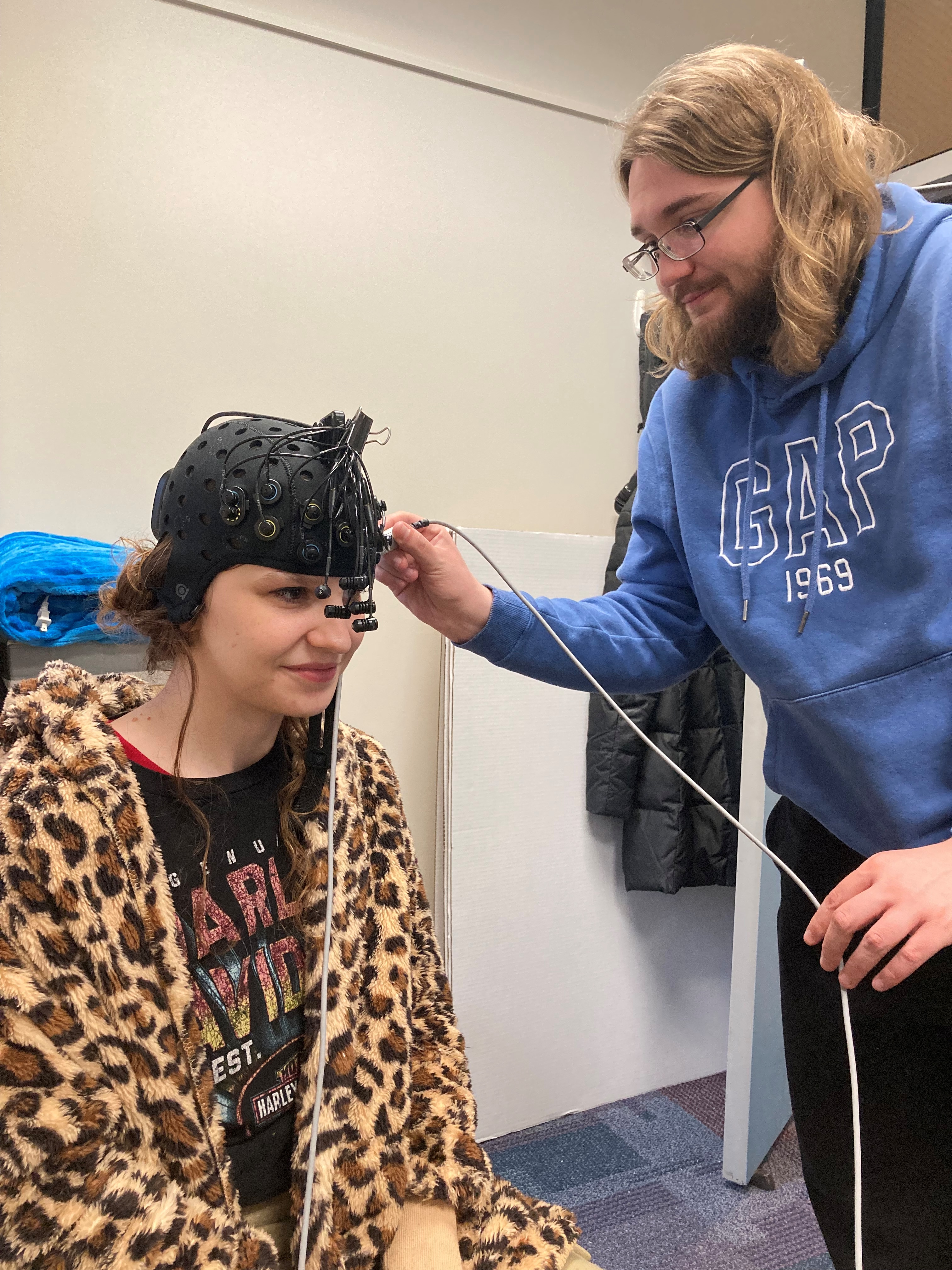
Should you re-read your notes until they're memorized, or actively quiz yourself with flashcards? Over the past two semesters, Kent Salem psychology major Gavin Sefsick and his faculty mentor, Dr. Rachael Blasiman, have been designing and piloting a study to examine this question with the help of the BHRI’s Neurocognitive Collaboratory. They chose to use the Artinis Brite fNIRS system, which is a non-invasive brain imaging technique that tracks changes in blood oxygenation in the brain. The basic principle is straightforward: when a region of the brain becomes more active, it demands more oxygen. fNIRS detects this by shining near-infrared light through the skull and measuring how much is absorbed by oxygenated versus deoxygenated hemoglobin. The Brite system is portable and wearable, which allowed the research team to bring the equipment directly to the Salem campus.
The experiment used a within-subjects design, so that each participant experienced both study conditions. Participants were randomly assigned to start in one of two conditions: active retrieval, in which they used flashcards to study material from a lecture they haven't previously seen, or passive rereading, in which they reviewed notes taken from the same lecture. Following both study sessions, participants completed a quiz on the material. Throughout each study session, the fNIRS device continuously monitored oxyhemoglobin levels in the prefrontal cortex, which is a region strongly associated with working memory, executive function, and effortful cognitive processing.
The research builds on a growing body of literature using fNIRS to study learning and academic performance. Prior work has used similar video lecture and quiz paradigms to examine hemodynamic changes during learning and many researchers have reported that flashcard use correlates with higher GPAs and test scores, suggesting active retrieval confers a measurable advantage over passive study strategies. This study aims to extend that line of work by directly comparing the two conditions while participants are wearing the fNIRS device, something that has not been done in quite this way before.
The pilot data collection phase has been completed successfully, and the team is currently in the analysis stage. They are examining whether the two study conditions produce measurably different patterns of prefrontal activity, and whether those differences correspond to quiz performance outcomes. The results, once analyzed, have the potential to offer students concrete, brain-based guidance on how to study more effectively and maximize their learning experiences.