
Smishing
Smishing is a form of social engineering that exploits SMS, or text, messages. Attackers send text messages claiming to come from legitimate services. These fake text messages can contain links to dangerous webpages, email addresses, or phone numbers.
Just like in email phishing attacks, cyber criminals often play on your emotions to get you to act by creating a sense of urgency or curiosity. They do this by saying you have won a prize, or that you have to “immediately” respond to or else something "bad" happens. This is all an attempt to convince you to provide sensitive information quickly, without realizing it is a scam.
(Click to enlarge)
-
BMV Smishing
In smishing attacks, scammers often send messages imitating the BMV. These fake messages will typically inform you that you have an outstanding traffic ticket. The text then instructs you to pay a fine immediately to avoid punishment. This attack focuses on urgency to get you to give up your personal or financial information quickly, before you realize it is a scam.
Spotting and Stopping Messaging Attacks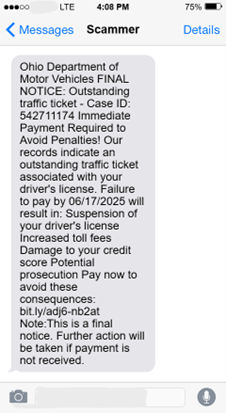
- Check the phone number from which the message is being sent. Is it affiliated with the Ohio BMV? Does the sender’s number match up with any of the contact information seen on the official Ohio BMV website? If not, then you should delete the message and block the sender.
- These messages may contain URLs to fake websites that look like the official Ohio BMV website. Clicking on these links without first verifying that they are safe can lead to your device being infected with malware. More in-depth information on finding out if these links are malicious can be found on our malicious links webpage.
- When looking at the message, is there a sense of urgency to scare you into making a quick decision? Scam messages tend to rush you into making quick decisions, creating a stressful time crunch. This tactic creates heightened vulnerability in users and increases the scammer’s rate of success.
- Please share this information with anyone you can think of to help keep everyone safe from these attacks. Our team has prepared additional information about fraud recovery to help keep you safe!
Remember:
Government agencies will never contact you via text message. The Ohio BMV will never send you a text demanding payment or personal information. If you ever get an alarming message from an organization, call or email the organization back directly. Do not use the contact information provided in the message. Always go to the organization’s website and use a trusted and verifiable phone number or email. The official Ohio BMV website can be used to contact them directly.
- Check the phone number from which the message is being sent. Is it affiliated with the Ohio BMV? Does the sender’s number match up with any of the contact information seen on the official Ohio BMV website? If not, then you should delete the message and block the sender.