
By Mercury Foster
Undergraduate Student Intern
As we prepare to welcome three poets from the Cincinnati area to Kent State, we at the Wick Poetry Center want to introduce them and their unique perspectives before their readings onstage. The poems that they will share at the reading in the Murphy Auditorium are only pieces of their identities as poets. We hope that through asking some of our guest poets about their experiences and opinions, their answers will help crystallize the fragments their poems give us into a fuller image of them. My name is Mercury. I’m a Wick intern who helped craft the seven questions of this interview.
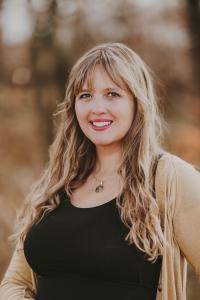
The first author I interviewed was Felicia Zamora. To me, Felicia is a jack of all trades in poetry: she’s the author of eight poetry books, is an associate professor of poetry at the University of Cincinnati, is a poetry editor at the Colorado Review, has received several awards for her poetry, and has been faculty for The Kenyon Review Residential Workshops. The second author I interviewed was Sara Moore Wagner. Sara’s journey with poetry is aspirational: she’s received accolades from the likes of the Sustainable Arts Foundation and the Ohio Arts Council, is the author of three award-winning books, and is the Managing Poetry Editor of Driftwood Press.
Felicia Zamora

Mercury: Who are you reading right now?
Felicia: I’m currently re-reading The Selected Poems of Nikki Giovanni because, well, I need her— the world needs her right now. I’m also finishing up some essays in Latinx Environmentalism: Place, Justice, and The Decolonial edited by Sarah D. Wald, David J. Vázquez, Pricilla Solis Ybarra, and Sarah Jaquette Ray. I’m also in the middle of Donika Kelly’s The Natural Order of Things, Cathy Linh Che’s Becoming Ghost, and Joshua Jennifer Espinoza’s I Don’t Want To Be Understood.
Mercury: What was your literary background before you became an author?
Felicia: I think I’ve always been a poet. However, before publishing my first book or even before obtaining an MFA, I was always working in roles where writing and building narratives was a part of the work. We are people; people need stories. Storytelling is a part of higher education, which I’ve been in for most of my working career. Stories are powerful. My current project is a hybrid book of poems around climate change, so I’m thinking a lot about how science and storytelling are deeply intertwined.
Mercury: Which craft techniques do you like using in your poetry and why?
Felicia: Prose poetry will forever teach me things. I love that it’s a form borne of resistance, as prose and poetry feel in tension from the get-go. This is also why I love the Zuihitsu form and its inherent associative leaping. I also find myself drawn to surrealism and critical fabulation, especially when working with diasporic lineage that colonization has erased. Using the nanoscene (which might be a term I made up) which uses quick bursts of dialogue, setting and scene to deepen the poem’s world and experience. Prose and poetry are lovers, not enemies, in my mind. Juxtaposing vivid imagery with more abstract statements in a poem also feels exciting to me.
Mercury: How do you navigate rejection in editing and publishing?
Felicia: For early or emerging writers, rejection can feel tough. That’s valid. I’m at a place in my life where I understand that rejection is just part of things. I submit to journals just like everyone else. I get my reject-minus and reject-plus responses, and it doesn’t really faze me. Sometimes, you just need to find someone who sees your work, champions it behind closed doors. I remember this, so I know that, eventually, someone might champion mine. I’m also an editor myself; I have been for years. I hope to be that champion for others. Just remember rejection is not necessarily because of the poetry, sometimes it’s just who’s reading, when they’re reading, and the aesthetic that appeals to those readers.
Mercury: Who has inspired you on your writing journey? How did they resonate with you?
Felicia: My mom. She wrote children’s books in the ‘80s but never had a single one published. Class divides in publishing are real. The poets Joy Harjo, Nikki Giovanni, and Dionne Brand helped shape who I am today as a poet. Honestly, though, I’m inspired every day on this journey. Writers like Jen Rose Smith, Sara Ahmed, Christina Sharpe, Oliver Baez Bendorf, Cristina Rivera Garza, Annie Wenstrup, Claudia Rankine, Mai Der Vang, Chet’la Sebree, Sandra Ruiz, Dolores Dorantes, Douglas Kearney, and so many more guide me to take risks in my writing. Each one of these writers doubles down in their own unique voice and writing style while also pushing the possibilities of writing into daring new trajectories.
Mercury: What’s something that makes this world beautiful?
Felicia: Showing up for each other. Minneapolis is showing us this right now.
Believing that our liberation is bound to the liberation of all. Without a doubt, it is.
Not letting brute force—from our own government and beyond—destroy community, empathy, and families.
The power of people gathered in protest against fascism.
Mercury: What’s a key aspect to being a poet in Ohio?
Felicia: I see myself as being somewhat new to Ohio, as I’ve lived here just over five years. However, I see Cincinnati as one of my homes. The poetic community in Ohio feels uniquely genuine. Ohio feels a fervor for the arts— an energy that makes poetry and the arts alive. I don’t believe we create alone; our art desires to be in communion with others, and Ohio artistry makes this a place where the communing feels necessary.
Sara Moore Wagner
Mercury: Who are you reading right now?
Sara: I usually am reading or listening to at least one novel/nonfiction book while also reading poetry when I can! Currently, I'm reading Spoil by Alyse Bensel and The Mesmerist by Caroline Wood.
Mercury: What was your literary background before you became an author?
Sara: I've been writing poems for as long as I can remember. I got a BFA in poetry, but... then I was my own worst enemy. I didn't write for about 7 years. I was a single mom in grad school, thinking I'd get a Lit degree and teach, when a kindred spirit/mentor encouraged me to go back to my real passion (poetry).
Mercury: Which craft techniques do you like using in your poetry and why?
Sara: I love slant or interesting rhyme, form, and repetition (or thought rhyme). I think this comes from my love of sound/music, and my inability to be a musician.
Mercury: How do you navigate rejection in editing and publishing?
Sara: Rejection is hard. The short answer is that being an editor makes recieving rejection easier, and so does time. When I decided to return to poetry, having lived a bit more than when I was an undergrad, I had a naturally thicker skin. I resolved to collect rejections and improve myself. I have never submitted something assuming anything but rejection, and I still admire all the editors who reject me. I keep on trying. I know this has been said a thousand times, but as an editor, especially an editor who reads only blind submissions for a press which only accepts around 1%, I see how often I pass on good work on a whim—something moves me one day, and something as silly as a comma throws me off another. I also know that rejection can and does break poets. I have friends who give up because the weight of rejection is crushing, so I carry that weight a little when I hit "reject." Full lengths are the hardest for me because I know how much work goes into those. I try to say something specific about full lengths I have to pass on in the hopes that my work as an editor won't have a negative impact on someone's passion—but I also realize someone else's choices are not in my control. The same mentor who encouraged me to go back to poetry told me that, no matter what, the best rises to the top, and I try to keep that in my pocket. If I'm working on being the best I can be, rejection is meaningless. There are so many examples of writers and artists whose work was widely rejected in their time after all.
Mercury: Who has inspired you on your writing journey? How did they resonate with you?
Sara: I am amazed by women who carve out time to write as mothers, especially those who don't come from an elite background, really. Diane Suess is the perfect example of this. I am in awe not only of her work (and how said work has risen to the top by its merit alone), but also how she navigates the literary community with such grace and kindness. Wouldn't we all love to be her? Maggie Smith and Nancy Reddy are the same. They are both powerful examples of how to keep your wildness and creativity as a mother, and I love to read the things they say about it.
My first poetry obsessions were H.D., Dickinson, and Plath, who all taught me to embrace weirdness, but I always say I'm only a poet because I found Tori Amos's Little Earthquakes when I was twelve. I felt she was watching me in a way, that she understood some locked up part of me and could translate it into the strangest words and images. I wanted to do that too.
Mercury: What’s something that makes this world beautiful?
Sara: Always kindness. I think if people are kind, they are naturally curious, too, and curiosity makes us all better. My biggest achievement is that I have really kind kids, and they amaze me with the dreams they have and the way they see the world.
Mercury: What’s a key aspect to being a poet in Ohio?
Sara: This is a tricky one! I have only lived in Ohio and South Korea (well, I work in northern Kentucky, which is basically Cincinnati?), so I don’t really know what poets in other states do, beyond what I've heard about how lucky those NYC poets are to have the community and resources! I live in a suburb and often, being mostly a stay-at-home mom, feel pretty isolated from other poets. I don't actually know any other poets in West Chester, though there are great ones in the surrounding areas.
One key aspect for me is finding community where I can, so I talk to a small group of other poet-moms who live thirty minutes to an hour away daily. We share our struggles and meet when we can, and this makes me feel less like an island. I also work images of the Appalachian Ohio of my childhood, into a lot of my poems. There are so many pockets of Ohio like that. Down here feels almost like the South, whereas Cleveland and Bowling Green, where I went to undergrad, are like different planets. I come from a strange Ohio mix of poverty and suburbs, which you may find everywhere, but I hope that makes my voice unique.