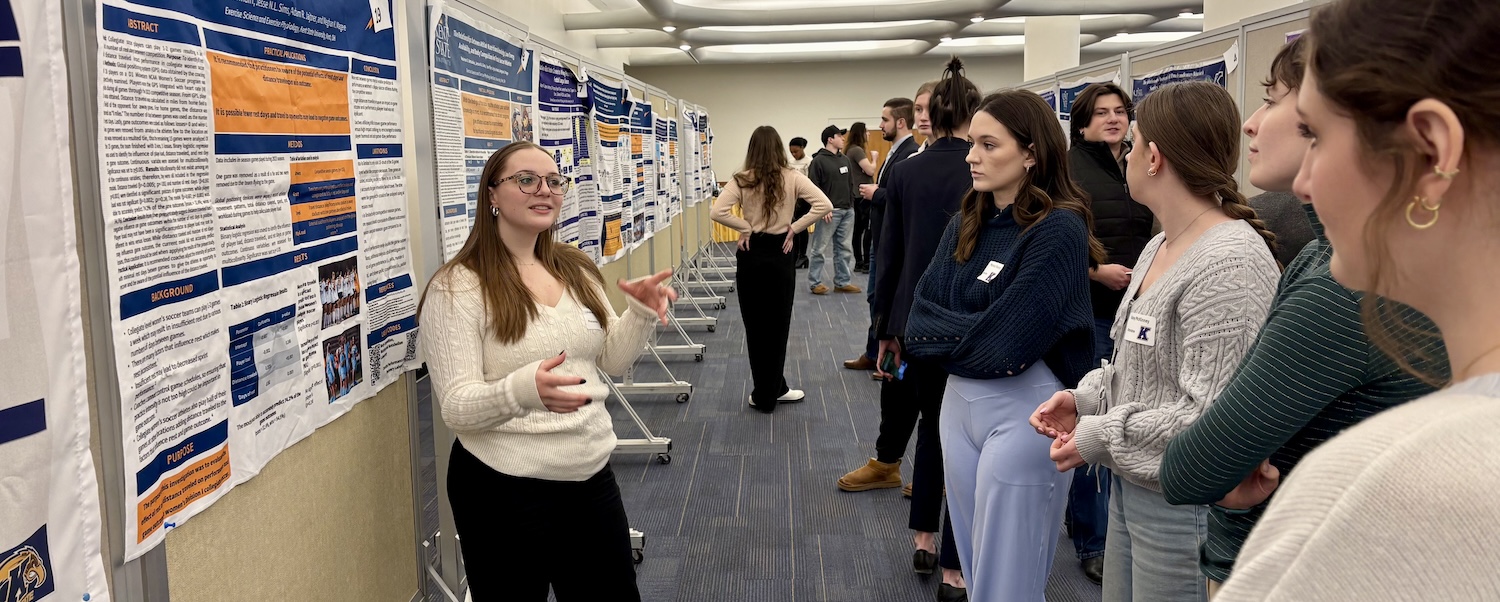
Sports fans watching Kent State women’s soccer last season might not have realized that the action on the field doubled as a months‑long research project. Throughout the season, players wore chest‑strap heart‑rate monitors that captured detailed internal‑load and performance metrics during practices and games. That continuous stream of data, everything from heart‑rate patterns to sprint performance, became the foundation for two research projects that would eventually reach a national stage.
Two Kent State University undergraduates brought national-level research experience to campus this year as featured presenters at the 2026 Exercise Science Summit. Liliana St. Germain, a senior exercise science major from Dublin, Ohio, and Olivia Snedeker, a senior sports medicine major from Mayfield, Ohio, delivered their work to a packed audience following their presentation at the 2025 National Strength and Conditioning Association (NSCA) National Conference.
Both students’ projects began with performance and biometric data collected from the Kent State women’s soccer team.
St. Germain and her team analyzed how rest days and travel distance influenced game outcomes in Division I women’s soccer athletes.
“During the data collection phase, we were given daily reports on players overtraining or physical load accumulated to levels of concern,” Rob Marinaro, head coach of Kent State’s women’s soccer team, said. "When we had players reach those levels, we would have to adjust their workouts. It was consistent data of players' output levels."
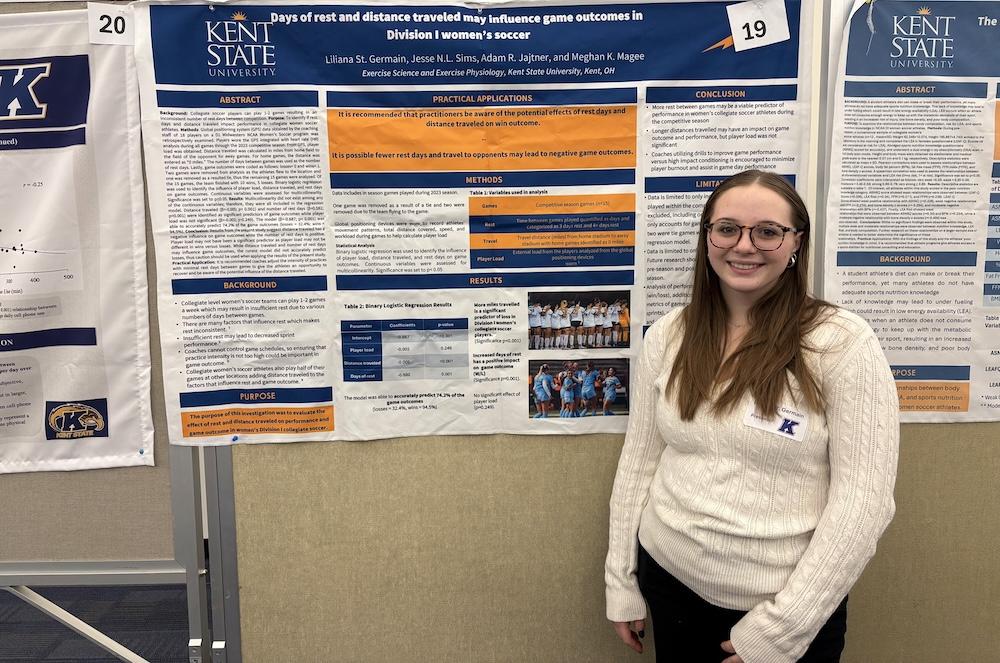
“So, game outcomes were all based on wins or losses, so anything other than that, like ties, they were taken out,” St. Germain told Kent State Today. “And then on top of that, game performance is based on sprints, so that's the way we worded that. And then all of the travel was based on miles on the ground. So, anything flight was taken out.”
Overall, St. Germain thought it was a very interesting and fun experience.
“People assume travel hurts performance, but seeing it confirmed in the data was really interesting,” she said. “It made me think about how the sports world could adjust scheduling to support athletes better. Home-field advantage is real, and my project really highlighted why.”
St. Germain’s findings aligned closely with what the coaching staff observed throughout the season.
“For some, workload would get too high, and then for others, we needed to increase activity to maintain proper fitness for peak performance. Both are injury prevention decisions,” Marinaro said.
Snedeker and her team examined how temperature is not a predictor of peak heart rate in Division I women’s soccer athletes.
Her first analysis suggested a clear relationship, but her second project, the one she presented at the national conference, revealed a more complex picture.

“It turns out temperature isn’t the only factor,” Snedeker said. “Dehydration, position played and other variables matter too. At first, I was overwhelmed by the data, but presenting it to experts made me realize I understood it more than I thought.”
Snedeker recalled speaking with a researcher whose entire career focused on thermoregulation, the exact topic of her poster.
“That was terrifying at first,” she said. “But it was really interesting to hear his opinion on it and get some of that feedback. It made me more confident reading stats, and it made me like research more than I expected.”
St. Germain said the conference pushed her to network boldly.
“I was walking around meeting people, former presidents of organizations, major figures in the field,” she said. “Networking at that level is completely different. It made me realize I could hold my own in those spaces.”

Both students credit Meghan Magee, Ph.D., assistant professor of exercise science and physiology, as the mentor who guided them through the process.
“She helped us through the entire thing,” St. Germain said. “Our posters would’ve been a jumbled mess without her.”
Snedeker agreed.
“It’s not just the information; it’s making it look professional,” Snedeker said. “She taught us how to answer questions, even when we didn’t know the answer. She’s absolutely my mentor.”
Magee said the summit was created to give students exactly these kinds of opportunities.
“I just think it is a really good experience for our undergrads to see what it's like,” Magee said. “It’s a good test trial for some of our students that are kind of interested in presenting at conferences, but are not quite sure, and then they’re like, ‘oh yeah, this wasn’t so bad, I’d love to do it,’ so then we've been able to take students to national conferences.”
Both students say their time at the national conference changed how they approached this year’s Kent State summit.

The 2026 Exercise Science Summit, hosted by Kent State’s exercise science and exercise physiology programs, brought together more than 100 attendees from across Northeast Ohio and beyond. Alumni, faculty, researchers, fitness professionals and industry partners gathered for a day of poster presentations, distinguished speakers, food and networking. A social event in downtown Kent closed out the conference.
While the summit highlighted the students' interests across Kent State sports data, St. Germain and Snedeker’s work stood out as an example of how far undergraduates can go when given the opportunity. Their session on the Friday of the summit drew significant attention from attendees eager to hear how undergraduate students had already stepped onto a national stage.
“The exercise science summit that we started doing here is really for our students to be able to fundraise for traveling to conferences and also give our undergrads an opportunity to kind of see what an actual conference would be like,” Magee said.
Some of the conferences that the summit is helping students travel to are the American College of Sports Medicine Conference in May and the NSCA National Conference in July, opportunities that continue to grow as the program expands collaborations with sports medicine, public health and nutrition.
St. Germain and Snedeker emphasized that students in similar fields need to take any opportunity that they can get.
“Opportunities like this are rare,” Snedeker said. "If something comes your way, take it. It’s going to help you more than you realize.”