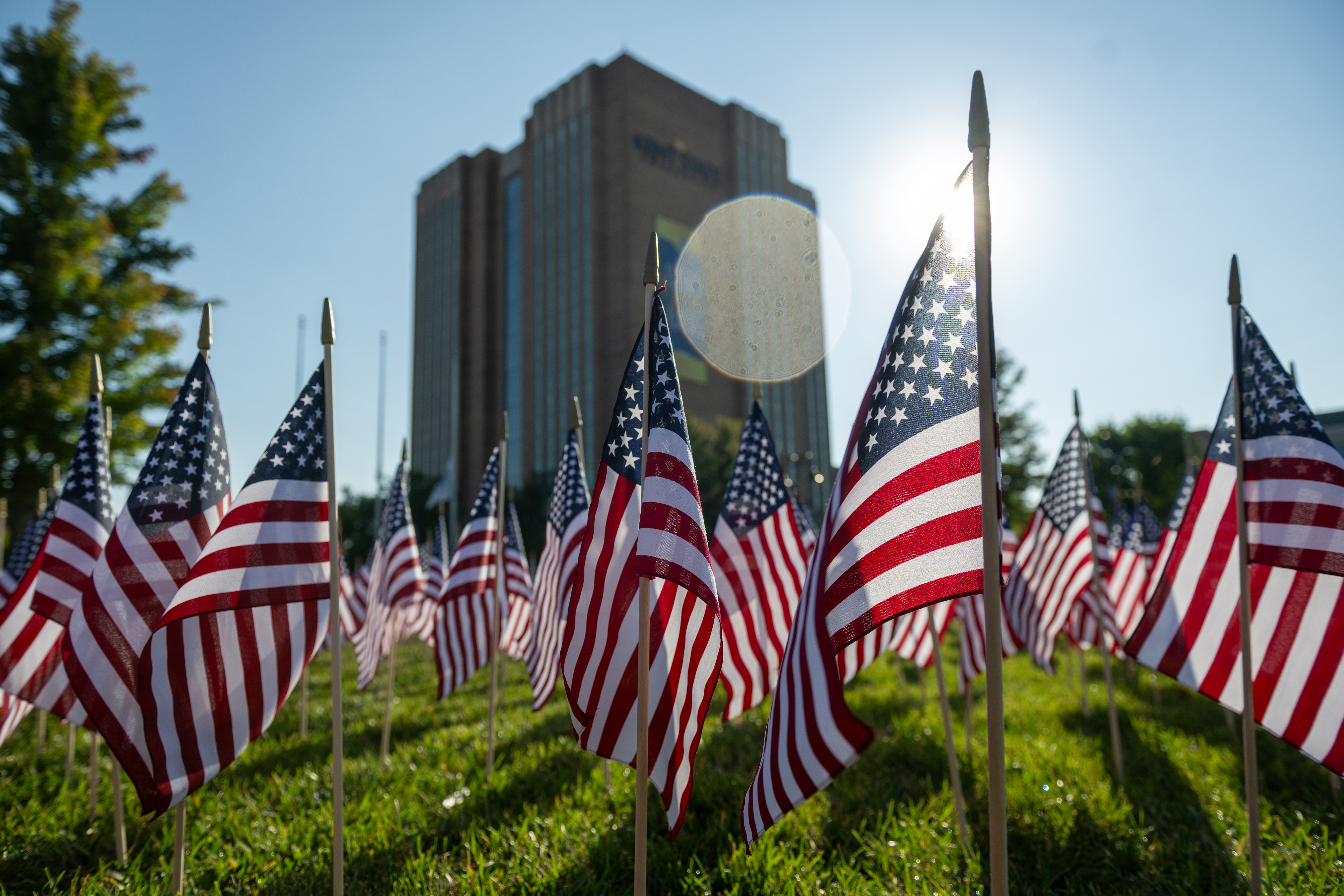
Twenty-five years after the 9/11 attacks, journalists who covered that day still remember the uncertainty and urgency that shaped their work.
Kent State University School of Media and Journalism faculty members were among those working in newsrooms that day, springing into action to cover the developing tragedy and help the American public understand what happened.

They recently told Kent State Today how their experiences continue to influence how they teach the next generation of journalists to cover traumatic events.
“I'm looking out the window of this downtown Akron building, and it's a beautiful clear day, and there are no planes up,” recalled Mitch McKenney, associate professor and former metro editor of the Akron Beacon Journal. “You're looking out there and just kind of thinking, 'OK.' This is a time when everybody really felt vulnerable.’”
Associate Professor Dr. Gretchen Hoak, who now researches the effects that covering traumatic news stories can have on journalists, said 9/11 was one of the first events to bring journalists’ mental health into a broader national conversation.
“There was a lot that happened to those folks from a mental and psychological standpoint,” Hoak said. “[9/11] was really instrumental in kind of starting the ball rolling on this conversation about what the job can do to journalists.”
All three faculty members said their experiences covering 9/11 shaped how they teach students to cover difficult events.
“A lot of what we talk about in our classes is, how do we recognize those feelings? How do we manage those feelings?” said Mizell Stewart III, professional in residence. “How do we separate that, for the time period that we have to get answers to some critical questions, but at the same time, channel those emotions in productive ways? I mean, I think sometimes those emotions lead to deeper stories, better stories.”
Listen to the conversation by clicking the link at the top of this article.

Podcast Highlights:
00:00 Hoak, McKenney and Stewart reflect on where they were working that day and how their newsrooms pivoted to cover the developing story
08:05 Hoak and McKenney discuss processing their emotions in the following days
11:58 Hoak discusses her doctoral research on journalism and trauma at Kent State, and how Sept. 11 helped put journalists’ mental health on the map
14:35 McKenney, Hoak and Stewart share how they teach Kent State students about Sept. 11 and the importance of recognizing emotions while covering difficult stories
The conversation features:
- Dr. Gretchen Hoak, Associate Professor, who was a television reporter covering the police beat for a Toledo NBC affiliate,
- Mitch McKenney, Associate Professor and Undergraduate Coordinator, who was an editor at the Akron Beacon Journal,
- Mizell Stewart III, Professional in Residence, then-managing editor of the Tallahassee Democrat,
- Anna Huntsman, Content Creator