As demand for behavioral health professionals continues to rise across Ohio and the nation, Kent State University is preparing graduates to not just enter the field right away, but to advance, lead and make a lasting impact in their communities.
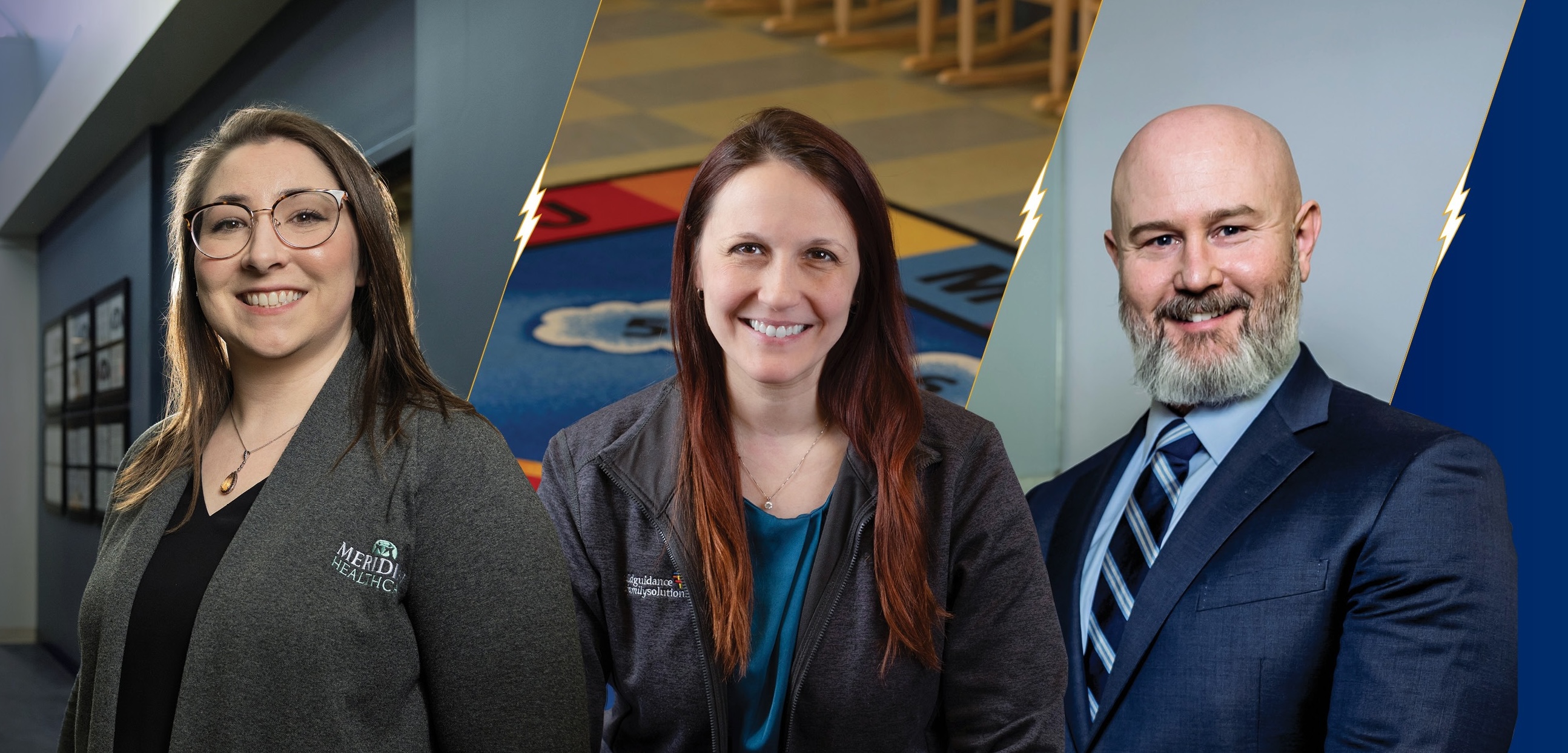
For three Kent State alumni — Cassandra Galloway, Victoria Giegerich and Jason Joyce — their paths may differ slightly, but their experiences at Kent State reveal striking parallels. Together, their stories illustrate how Kent State connects education to real-world outcomes.
With more than 174,000 Ohio youths reporting mental health struggles in 2025, and more than 2.1 million Ohio adults (nearly one-quarter of the state's population) experiencing some form of mental illness, the need for support resources has never been greater. The demands in Ohio have been driven by several factors, including an opioid overdose epidemic and the increased mental health struggles that followed the loss and isolation of living through the COVID-19 pandemic.

Kent State's College of Education, Health and Human Services offers a number of degree programs for students looking to pursue a career in this field, including master's degree programs in clinical mental health counseling, clinical rehabilitation counseling and school counseling, as well as a doctoral program in counselor education and supervision. The three master's degree programs and doctoral degree program are nationally accredited by the Council for Accreditation of Counseling and Related Educational Programs. A non-degree certificate in addictions counseling is also offered.
Entering the Workforce with Confidence

Rather than feeling overwhelmed entering behavioral health roles, Galloway, Giegerich and Joyce each describe a sense of preparedness after graduating from Kent State, which carried them through early career transitions.
For Jason Joyce, who earned his master's degree in community counseling from Kent State, the university helped launch a career that quickly progressed into leadership roles. He was recently named chief executive officer (CEO) of the Alcohol, Drug Addiction and Mental Health Services (ADAMHS) Board of Cuyahoga County. Knowing since high school that he wanted to be a therapist, Joyce said pursuing dual licensure at Kent State helped him advance quickly. He also credits the real-world skills learned during practicums and internships for helping him hit the ground running after graduation.
"One of the things that really stood out when I first started at Kent State was how they really focused on practical knowledge. It wasn't all theoretical; you were able to take what you learned and then sort of quickly sort of translate it to what it would be like at a job," Joyce explained. "An example of that was that they start you off in the counseling program and you get sort of the base skills you would need but then they kind of quickly move you to your practicum, your internship."
Joyce explained that having counseling sessions recorded with instructors and supervisors providing feedback helped him feel better prepared.
"When I got out there, I felt that I had a leg up on the competition – one, for interviews, I was able to land the job pretty quickly, so that was great. And then two, when I started out in the field, it was easier to be more successful because I already had some of those reps in that practice before [I graduated.]"
Joyce also emphasizes the value of his specialized training during his internship, which positioned him for success in an emerging area of practice.
"One of the things that my internship did was — and this is something that you have to sort of look into as well — at the time, that was actually really rare," he said, referring to integrated behavioral health training. "So, I was able to get that first job being a co-occurring sort of therapist, that you do both sort of things. That helped me sort of launch there."
His career progressed from direct clinical service to executive leadership, including multiple roles within the same system. "I had multiple roles … I was able to [advance] within that system," Joyce said. Most recently, he served as president and CEO of The Hitchcock Center before taking his current role at the ADAMHS Board.
As a leader, Joyce continues to give back by mentoring students and supporting the next generation of professionals, reinforcing Kent State's role as a workforce pipeline that extends well beyond graduation.
From Intern to President and CEO

Cassandra Galloway didn't originally set out to be a licensed counselor. Growing up in Strongsville in Cuyahoga County, she initially thought she would pursue a career in business — until she encountered economics, which quickly changed her mind about a business career.
"I got my bachelor's at the University of Akron in psychology, my master's for community counseling — it was community counseling at the time at Kent," Galloway said. "And then just a year ago now, I got an MBA from the University of Akron. So, I circled back to business. Still hated economics though," she joked.
After earning her Bachelor of Arts in psychology, Galloway decided to continue her education at Kent State to complete her master's degree in community counseling. It was here that she took part in an internship at Child Guidance and Family Solutions, a local agency with about 130 full-time employees — and essentially, never left.
"All counseling programs require practicum and internship experience. So, I did my internship at Child Guidance during my final semesters at Kent State. And then when I graduated, there were not any job openings and that's why I took some time, just a couple months, before coming back here," Galloway explained.
Today, Galloway serves as President and CEO of Child Guidance and Family Solutions, the same organization where she began as an intern. "Kent State helped me find my confidence and trust that I belonged in this field," Galloway said.
From her leadership position, Galloway has a clear view of how the field has evolved — and how demand has intensified in recent years.
"I think our field has always been short in workers, right? It's always been. But I don't think that it was so prevalent until 2020. This is no secret, right? We all know 2020 impacted every single thing," she said.
Galloway has witnessed a significant cultural shift in how young people view mental health treatment. "Once upon a time going to therapy was like, 'Oh no, don't tell anybody, say you're going to the doctor,' you know, whatever it is. It was so stigmatized. And not that that has gone away, but I think with the youth that we see now, they just talk about it so openly.”
But alongside increased openness has come increased severity of mental health challenges. When asked if she sees the demand slowing down, Galloway is clear: "I definitely don't see it slowing down. I think the demand will continue to increase."
The staffing challenges are real, particularly in community mental health settings. "Like many places, you know, when 2020 came along, we lost a lot of staff, you know, because the opportunities just exploded," Galloway said.
Despite these challenges, Child Guidance has maintained a strong relationship with Kent State as a reliable source for well-prepared clinicians. "We have a Kent student at least every semester. A lot of the schools we work with are great, but the Kent interns are always amongst the most well-prepared. I mean, by far, you know. And we say that all the time here. It's like the education they're getting and the training — it's phenomenal."
For Galloway, interns represent more than just temporary help — they're the organization's primary pipeline for hiring permanent staff. "Interns are our pipeline for hiring. And I have always loved that because I think when they come here as interns, we get to train them in a slower way. Because when you start any other new job, you got a couple of weeks and it's like, all right, you got to go, do all the things. Whereas when they're interns, we can really take more time, and they can do more observations, and they can learn how to manage risk. And by the time they're ready to actually take a job, we know — we've seen them. We've been working with them, so we know how they're going to respond."
How Faculty Experiences Helped Her Find Her Voice
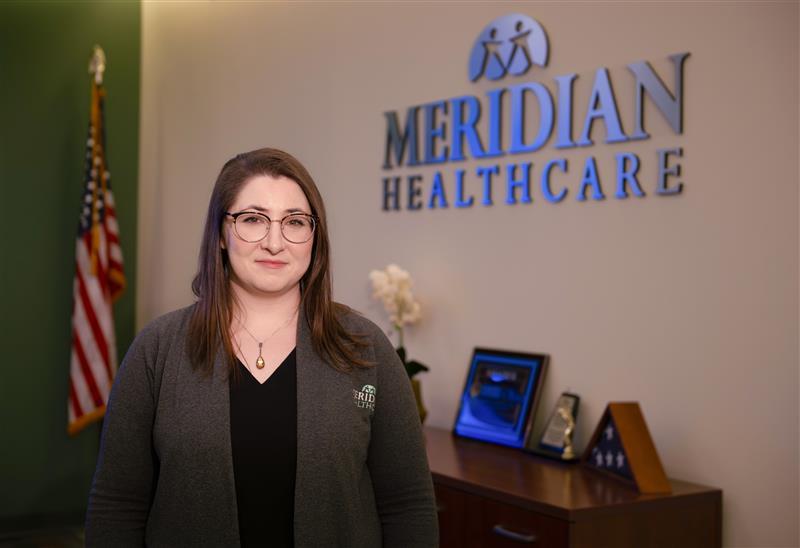
Victoria Giegerich grew up in Northeast Ohio. After earning her doctorate in Counselor Education and Supervision from Kent State in 2019, she has maintained a strong connection to the university, currently serving as an adjunct instructor teaching theories and practices in addictions counseling, in addition to serving as chief clinical officer of Meridian HealthCare.
Giegerich describes the doctoral program as uniquely comprehensive in its approach to professional development. "I think counselor education and supervision is really unique because there are five core areas that you're really trained in during that program. It's supervision, teaching, research, counseling and leadership," she explained. "So that's kind of the beauty of that program, is you get exposure to all of those."
That exposure translated directly into professional involvement and leadership opportunities. From the leadership component, Giegerich became involved with the Ohio Substance Use Disorder Professionals group, a division of the Ohio Counseling Association, eventually serving as president. She also participated in ASERVIC, the Association of Spiritual, Ethical, Religious Values in Counseling. "Those were things that were through professional organizations, but I would say that that was really promoted by faculty who were also deeply involved," she noted.
Even after completing her doctorate, Giegerich stayed connected to Kent State through the motivational interviewing learning community, a group she created with her then faculty mentor, Cynthia Osborn, Professor Emeritus of Counselor Education and Supervision at Kent State. The community was designed "to basically support clinicians in the field in maintaining an evidence-based practice," Giegerich said. "And I would come in and sometimes I would role-play as a patient. Sometimes I would practice skills myself."
The value of this kind of ongoing, in-person engagement cannot be overstated, according to Giegerich. "What really stood out at Kent, and I think part of why they have that engagement, is because they took the time and the effort to do those interactions, even though on the face of it, that's not something that looks profitable."
As a graduate assistant, Giegerich had opportunities to teach and co-teach courses, experiences that proved formative in discovering her professional identity. Those teaching experiences helped Giegerich develop her professional voice. "From the teaching standpoint, that's where I kind of learned, OK, this is my voice when I'm educating, and this is how my voice needs to shift. And when are the times that I need to step back and have more of a constructivist perspective with the students and allow them to find their voice?"
One particularly pivotal experience came through the supervision course taught by the late Betsy Page. "We had to take a supervision course that at the time was taught by Betsy Page. She's no longer there. She passed while I was in the program, but when I worked with Betsy, she was very direct," Giegerich recalled. "And she said, ‘you know, Vicki, you're not going to be happy in your job until you're a supervisor, because that's where your skill set really is.’"
At the time, Giegerich didn't see herself that way. "I was still very much in my mind a clinician and I enjoyed understanding systems, how things work. I like to do case conceptualization, all the little details," she said. "But I didn't fully understand until I took the supervision course and I started having my own supervisees where my talents really lay."
That realization shaped her subsequent career trajectory. Looking back, she recognizes how faculty guidance shaped decisions that continued to influence her career long after graduation.
"Talking with Cynthia Osborn really helped me slow down and focus on what made the most sense for me at that time," Giegerich said. "I didn't realize it at the time, but that guidance really helped set me up for where I am now."
Learn more about Health Profession Pathways at Kent State.