Where are they now?: 2025 ESDRI Graduate Student Awardees

Follow up with the research funded by the ESDRI Graduate Student Award in 2025

The Environmental Science and Design Research Institute Graduate Student Award was founded in 2025 and has funded new research inquiries for 8 graduate students to date. The ESDRI Graduate Student Award operates on a bi-annual award cycle with application periods each February and September. Kent State University graduate students advised by an ESDRI-affiliated faculty member from any campus are eligible. They may be awarded once during their degree program, and not during their final semester. 

More information about the ESDRI Graduate Student Award, including full guidelines and scoring rubric, may be found here


We checked in with the 4 graduate students who received the award to fund their research during our pilot season in Spring 2025 and just finished those projects, and the 2 graduate students who were awarded in Fall 2025 and are in the midst of their funded work. 


Spring 2025


Kolapo Fasina

Biological Sciences, Cell Biology and Molecular Genetics

Expected graduation Spring 2027

Advisors: Laura G. Leff, PhD & Jean Engohang-Ndong, PhD

Project: Application of electron beams in removal of antibiotic resistance genes during tertiary treatment in wastewater treatment plants


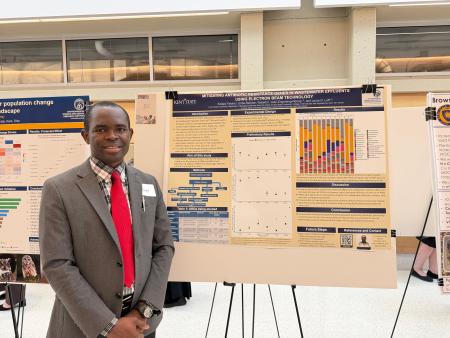
Kolapo Fasina

Kolapo applied for the Graduate Student Award to examine the effects of electron-beams on the removal of antibiotic resistance bacteria (ARBs) and antibiotic resistance genes (ARGs) from effluents of a selected wastewater treatment plants (WWTP) that discharged into the Cuyahoga River. 

The project had two major goals:

1. To determine how effective electron beams are in the eradication of ARBs and ARGs from WWTP effluents.

2. To determine if ARGs persist in effluents beyond filtration after e-beam treatment.


During the past year, Kolapo accomplished the following:

  •  Lab experiment using electron beams to treat wastewater effluents at 5 doses.
  •  Viable bacteria were cultured from different samples.
  •  Antibiotic resistance genes were quantified from the samples.
  •  Bacteria sequencing of the 16S rRNA genes was carried out.
  •  QIIME2 bioinformatics analysis and statistical analysis were conducted.

This project provided several opportunities for training and development including improvement of Kolapo's bioinformatics and statistical analytics skills. "I was able to engage in technical skills involving DNA extraction, 16S sequencing with the latest technology; AVITI Biosciences, which has more depth and gives cleaner data than data from Illumina Miseq or HiSeq. It also afforded me the opportunity for laboratory training on working in a Clean Room, working with radiation," said Kolapo.

Kolapo presented a poster titled “Mitigating Antibiotic Resistance genes in Wastewater Effluents using Electron Beam Technology” at the ESDRI Research Showcase on April 13, 2026. Up next he plans to carry out qPCR on the e-beam filtrates to understand if the ARGs persisted even after membrane filtration. And he will finish writing the second chapter of his dissertation, based on this project, later structuring the chapter into a journal article for publication.


Prashant Ghimire

Biological Sciences, Ecology and Evolutionary Biology

Graduating Summer 2026

Advisor: Sangeet Lamichhaney, PhD

Project: Altitudinal Migrants on the Edge: Evolutionary Relationships and Molecular Basis of High-Altitude Adaptation
 

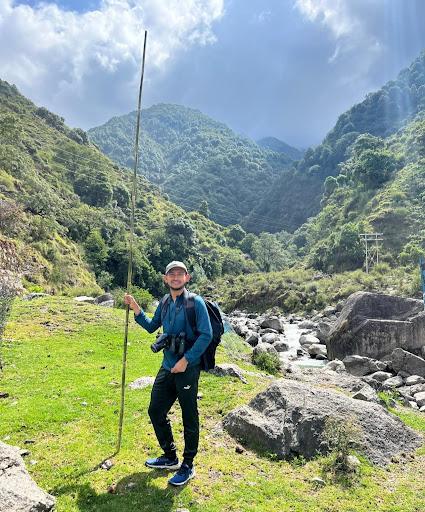
Ghimire in field

This work investigated the evolutionary relationships and population genetic structure of Black Redstart (Phoenicurus ochruros) across Asia and Europe, proposing developing the Black Redstart as a model system to study how birds colonize new environments, diversify, and adapt to extreme high-altitude environments across continents.

In this project Prashant set out to accomplish three main objectives:

  1. Resolve the evolutionary relationships and population genetic structure of Black Redstart across Asia and Europe, using genome-wide data to characterize subspecies boundaries and patterns of intra and inter-species gene flow.  
  2. Test the “Himalayan origin” hypothesis, exploring how biogeography and historical processes have shaped evolutionary pathways and the colonization of local populations of Black Redstart across diverse high-altitude habitats.  
  3. Characterize the molecular basis of high-altitude adaptation across different mountain systems and determine whether the genetic and molecular pathways associated with high-altitude adaptation are shared among Asian and European populations.  

Of the first objective Prashant shared, "We focused on four different redstart species and studied their evolutionary relationships and population genetic structure and resolved their taxonomy for the first time using whole-genome sequences. Our study revealed high genetic divergence among redstart species with no evidence of gene flow despite living in sympatry."

The high genomic divergences made it difficult to disentangle role of biogeography and climate, so the team used Tibetan partridge as model species for Objective. "[We] found that biogeography and climate shapes local adaptation and population divergence in mountain system," said Prashant. A paper on this objective was published in Molecular Ecology in 2025 and this work was also featured in Kent State Today: New Study Reveals How High-Altitude Birds Adapt to Life on the 'Roof of the World'.

Lastly, as stated above, high genomic divergence makes it difficult to pinpoint genes that drive high altitude adaptation especially with limited sample size, therefore, Prashant plans to do additional population scale resequencing from the sample collected across diverse elevation and region to achieve Objective 3. 

Prashant presented this work at a talk at the American Ornithological Society conference in St. Louis, Missouri in August 2025, a poster presentation at the ESDRI Research Showcase in April 2026, and recently at Evolution 2026, Cleveland in June.

In May 2026 Prashant successfully defended his doctoral dissertation "Molecular basis of high-altitude adaptation in birds" and will officially confer his degree in August 2026. After graduation Prashant will begin his David H. Smith Conservation Research Fellowship, a prestigious postdoctoral fellowship, at Colorado State University. 

Read more about the Smith Fellowship and Prashant's KSU journey


Harlee Rush, PhD

Biological Sciences, Ecology and Evolutionary Biology

Graduated Spring 2026

Advisors: Oscar Rocha, PhD & Mark Kershner, PhD

Project: Decay above the clouds: Elevation Alters Leaf Litter Chemistry, Decomposer Activity, and Decomposition Rate


Harlee Rush

Harlee used this award to hire two undergraduate research assistants to help process invertebrate samples from Costa Rica and assist with chemical analyses. 

The project had five major goals:

  1. Evaluate drivers of decomposition by determining how environmental factors such as elevation and species-specific leaf chemistry influence leaf litter decomposition rates in tropical montane cloud forests.
  2. Test the home-field advantage hypothesis by assessing whether litter decomposes faster in the environment where the plant species naturally occurs.
  3. Assess invertebrate community responses by examining how invertebrate diversity, abundance, and litter preferences vary across an elevational gradient.
  4. Link leaf chemistry to ecosystem processes by analyzing compounds such as condensed tannins, phenolics, structural compounds, and C:N ratios to understand how chemical traits influence decomposition and nutrient cycling.
  5. Train undergraduate researchers and communicate research findings through hands-on mentoring, scientific presentations, and peer-reviewed publications that advance ecological understanding of decomposition in cloud forest ecosystems.

During the past year, the project successfully completed all field, laboratory, and data analysis components.  These efforts resulted in a finalized dataset that was used in Harlee's doctoral dissertation chapter focused on oak leaf decomposition through a reciprocal transplant experiment on a Costa Rican mountainside. Harlee shared the results saying, "Essentially, decomposition was influenced by oak species, elevation, and invertebrate access.  However, there was no evidence for a homefield advantage."  

A manuscript on this work is currently being prepared for submission as a peer-reviewed publication and will continue to be presented and incorporated into future work.

When asked about the opportunities for training and professional development this project provided, Harlee shared, "Through this project, I gained more experience in designing and implementing field-based experiments, managing multi-national collaborations, and processing biological samples in the laboratory, including invertebrate identification and chemical analyses of leaf litter. I also developed strong skills in managing and analyzing large ecological datasets using R, including statistical modeling and multivariate community analyses. Through this work, I strengthened my ability to interpret complex ecological patterns and communicate results through scientific writing, presentations, and manuscript preparation. In addition, the project provided valuable mentorship and leadership experience through training and supervising undergraduate research technicians. This included training in lab methods, supporting their development as researchers, and helping them get more involved in ecological research preparing for their future careers. Overall, the project significantly advanced my technical, analytical, and professional skills in preparation for a career in ecology and environmental science."

Harlee successfully defended their dissertation on 10 April 2026 and graduated with a Doctorate in Biological Sciences - Ecology and Evolutionary Biology in May 2026. 


Lakhvinder Singh

Biological Sciences, Ecology and Evolutionary Biology

Expected graduation Spring 2029

Advisors: Sarah Eichler, PhD (current), Brian Trevelline, PhD (former)

Project: Investigating how climate influences the avian gut microbiome


Lakhvinder Singh

With this award Lakhvinder requested funds to install a weather station on the roof of the recently established Kent State Aviary to measure how environmental variables influence microbiomes of captive house sparrows over time. The award also funded a mounting system and a cloud data storage subscription for 10 years. 

Although Lakhvinder has moved on from the project, the weather station was installed on the side of the aviary to collect preliminary data. The next steps are for University Facilities Management to permanently install the weather station on the roof with the permanent tripod structure and to work with IT to solve internet/network issues. Once these connection issues are worked out, the weather data will be shared with the broader community.

Even through these challenges, Dr. Trevelline shared that this project has allowed for training in remote sensing technologies as well as data collection and management.

All involved are looking forward to working through the technical issues and having this local weather data available for the whole Kent State community! 

Lakhvinder recently shared his work conducted with Dr. Eichler, Divergent fates: two decades of raptor population change across Ohio's shifting landscape, and won the inaugural Graduate Student People's Choice Award at the Environmental Science and Design Research Institute's Research Showcase.


Fall 2025


Nomi Ghulamullah

Mechatronics Engineering

Expected Graduation Fall 2027

Advisor: Yanhai Du, PhD

Project: Advancing Sustainability through Additive Manufacturing of Metal Matrix Composites


Nomi Ghulamullah

The major objectives of this ongoing project are to:

  1. Print metal and metal ceramic composites using DMLS process
  2. Characterize 3D printed parts 

So far, 430L soft ferritic steel has been printed in a design process parameter window. "We successfully printed our metal parts with various process parameters, but are still struggling with mixed ceramic metal powder printing due to equipment design limitations and suitable powder unavailability," said Nomi. The technical limitation caused by the ceramic powder being light and thus not allowing the shielding gas to uniformly distribute it to scan is a problem that they have encountered along the way. However, they have been committed to working through this issue and Nomi will continue the analysis needed for this objective.

Nomi shared, "Thanks to ESDRI for helping us manage the cost of the experiments. We printed numerous times to sweep the process parameters. It requires lots of shielding gas, plates cleaning and machining and lab consumables."

During the remainder of the award period Nomi plans to characterize the 3D printed parts to accomplish Objective 2. Then the data from this project will be used to generate a manuscript.


Aleksandra (Ola) Wasik

Geography

Expected Graduation Summer 2028

Advisor: He Yin, PhD

Project: Multitemporal delineation of crop field boundaries at a large scale to reveal agricultural land dynamics in northeastern Nigeria 


Ola Wasik

Ola's project aims to delineate crop field boundaries in conflict-affected regions of northeastern Nigeria from 2018-2025 using very-high-resolution (<2m) satellite images and Artificial Intelligence (AI) methods. "By accurately mapping field boundaries, the project will enable assessment of spatial-temporal dynamics of cropland fragmentation, and provide new insights into agricultural changes in conflict-prone regions," said Ola.

Though the project is still underway, and she has faced technical challenges with the data, she has made much progress, including obtaining ~40k very-high-resolution (VHR) imagery through NASA's Commercial Satellite Data Acquisition (CSDA) program; selecting four pilot studies to establish a deep learning framework, adapting models across different satellite sensors and geographical regions; and adapting NASA EVHR (Enhanced Very-High Resolution) Python workflow for this project purpose. Ola has even tested a preliminary post-processing strategy for data management and cleaning model predictions using additional machine learning methods, and obtained field photos and other supporting data from collaborations. 

When asked about her plans for the remainder of the award period Ola shared, "I will continue working in parallel on preprocessing VHR images with the EVHR workflow, downloading data, and developing a deep learning framework. I will continue refining the deep learning library implementation of the workflow and investigate differences to ensure reproducibility and consistency. Once this step is complete, I will proceed with customizing and evaluating model performance." 

Ola shared that so far this project has strengthened her expertise in geospatial AI, remote sensing and computer science methods with spatial data management. It has also provided great opportunities to collaborate with domestic and international researches, develop reproducible research workflows, and gain experience in preparing competitive research proposals, scientific publications, and outreach activities.
One of their collaborators, Dr. Fabien Cottier (University of Geneva), Dr. Yin, and Ola are planning a workshop in Geneva, Switzerland in November 2026 to disseminate the results to a larger scientific and policy audience.

Ola has presented this work at The American Geophysical Union's Annual Meeting in 2025 and the KSU Graduate Research Symposium in 2026. She has submitted a Dissertation Fellowship application and is currently working on another graduate student research funding application. 

Her end goal is to finish a peer-reviewed manuscript that will cover the technical framework of this project, and she intends for this project to support open science and reproducibility practices.  

 

POSTED: Monday, June 8, 2026 10:35 AM
Updated: Thursday, July 2, 2026 11:04 AM
WRITTEN BY:
Katherine McNamara Manning, PhD