
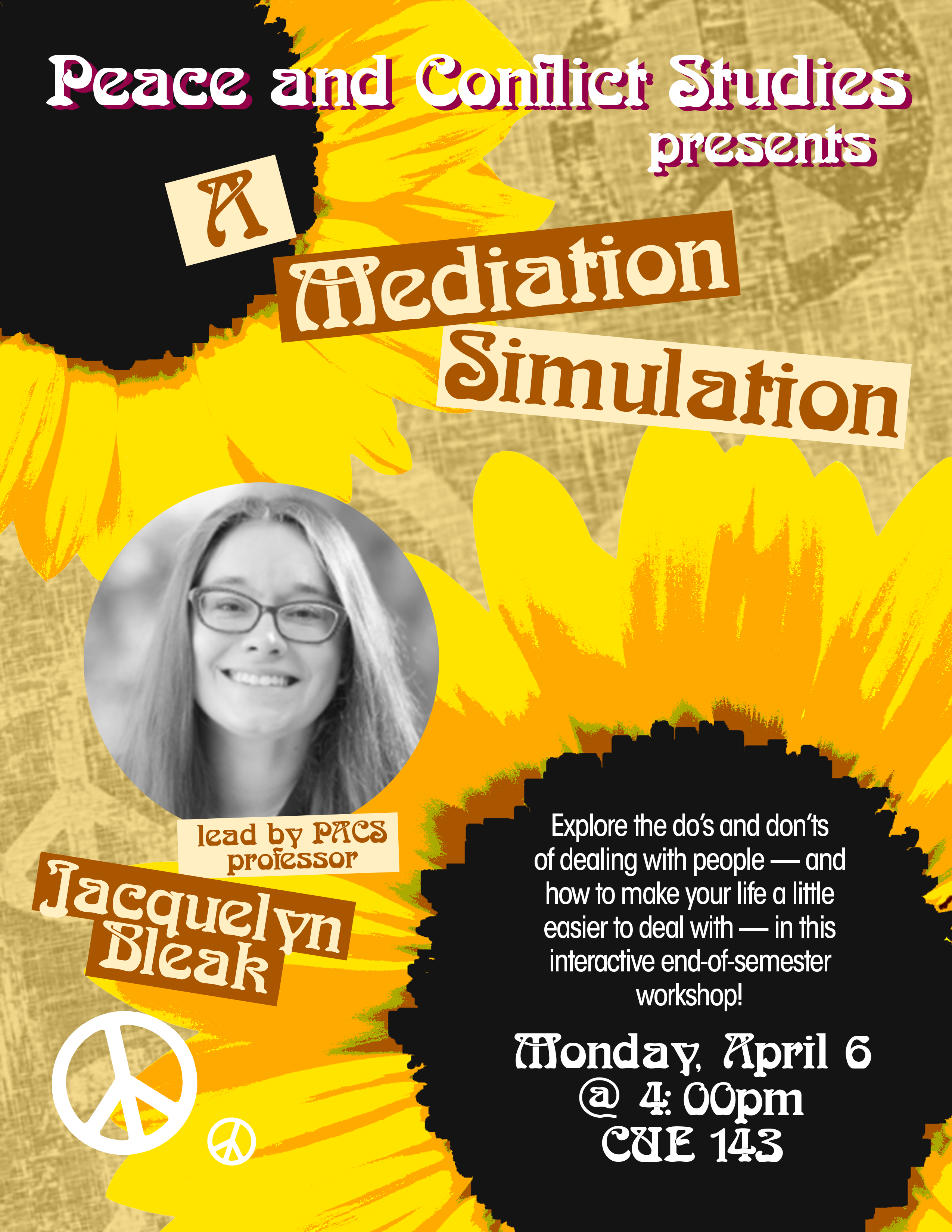
On Monday, April 6, 2026, Peace and Conflict Studies associate professor Jacquelyn Bleak treated Kent State students and faculty to an interactive seminar on one of the core tenets of her field: conflict mediation.
Bleak — pronounced “Blake” — has a master’s degree in Conflict Analysis and Resolution from George Mason University and teaches such classes as Intro to Conflict Management; Gender, Power, and Conflict; Conflict in the Workplace; and Mediation Theory and Training. Her presentation derived greatly from her curriculum for the former class, which teaches of the ‘roadblocks to communication’ that humans naturally encounter throughout their day-to-day conversations. Bleak emphasized that everyone struggles with them — that we are not necessarily socialized to be ‘good listeners’. Nor are these ‘roadblocks’ entirely unavoidable; which ones we use often vary between who we’re talking to and how close we are to them or are feeling to them in the moment.
One such roadblock stems from the misuse of praise and reassurance. Excessive compliments or assuming that struggle is inevitable to resolving a hypothetical problem, even if no problem exists. Bleak demonstrated this through an exercise with a student, who discussed her admission into a PhD program, which she is due to begin in the fall. In an intentionally exaggerated manner, Bleak confronted her with statements such as “That’s so difficult!” and “That’s going to be really hard for you, but it seems like you’re a strong person, so you got this.” While many may use such statements as a means of establishing relatability, said Bleak, they actually psychologically promote division in their reliance on judgment. In assuming a problem, they seek to press the metaphorical fast-forward button towards resolve, regardless of whether or not anything needs to be solved whatsoever; in any case, roadblocks derail conversations owing to assumptions about the initial speaker, not realities. In short, roadblocks put words in another’s mouth, generating misunderstanding even if their perpetrator does not realize it.
Bleak spoke much of the duality of what she calls ‘judging-mode’ — that animalistic state in which we perceive ourselves as either the victim when something happens to you or the hero when you feel you know better. She juxtaposed such mental fallacies with states of learning, in which we as humans build awareness of the world around them in a manner that is constructive as opposed to competitive. She used the example of a student coming up to her after class and asking her if everything was alright, as she seemed to be under stress. Having not had positive experiences with the student in the past, Bleak spent “forty-five minutes to an hour” being irritated with the interaction before realizing she was judging the student, and quite unfairly. As soon as she recognized her judgment, it was as if a large weight was lifted from her shoulders.
Building from David Foster Wallace’s famous speech to Kenyon College’s class of 2005, Bleak emphasized that such judgment often stems from the information overload that modern humanity is confronted with daily. Everyone, however, has the power to recognize their attitude, changing it as necessary to build connection. This process relies on the knowledge that life is difficult for everyone and that cutthroat mentalities often do more harm to not only one’s mood but their ability to not just sympathize with others — merely supporting them in poorly times — but empathize with them — truly understanding what they have gone through.
It is this shift from sympathy to empathy that stands as Bleak’s general message: to see others as full, multidimensional beings instead of what we want them to be, or need them to be as to suit our anxieties or anger. When we listen to others, the manner in which our compliments are worded calm brain chemistry instead of overwhelming them; when we say to another, “it sounds like you’re feeling this way,” we open conversations up to vulnerability. When we embrace such language, responses change, and for the better.
