
In a front porch conversation during the height of COVID-19, two Kent State University professors realized they had something in common beyond their neighborhood proximity: both were turning to poetry to cope with unprecedented stress and uncertainty.

Clare Stacey, Ph.D., a professor in Kent State's Department of Sociology and Criminology, and Heather Caldwell, Ph.D., chair of the Department of Biological Sciences, were witnessing their students struggle with mental health challenges that the pandemic had intensified. As scientists, they wanted evidence. As educators, they wanted solutions.
What emerged from that conversation became the Healing Stanzas Project—an innovative, interdisciplinary research initiative proving that poetry doesn't just move us emotionally; it measurably improves our mental well-being.
"We knew the data were coming out showing a clear impact of COVID on mental health," Stacey explains. "And we knew even as we were gearing to come back, this was just going to be long-term. Student mental health has been a problem for years, and COVID just put everyone into high gear thinking about it."
Both professors relied on poetry to process the isolation and anxiety of the pandemic. Both were friends with David Hassler, director of Kent State's nationally recognized Wick Poetry Center. The collaboration seemed natural: What if they could systematically study whether poetry interventions could help students the way it was helping them?
Science Meets the Humanities
The Healing Stanzas Project brought together an unusual combination of expertise: sociology, neuroscience, psychology, nursing, and poetry. This interdisciplinary approach reflects how modern research increasingly crosses traditional academic boundaries to solve complex problems.
"It's rare to have somebody who's a poet working with a neuroscientist working with a social scientist," Stacey said. "I think that combination in particular is unusual, and I think that's an asset to it."
The project has influenced how faculty across disciplines approach teaching. Professors in biological sciences and physics have begun incorporating poetry into their classrooms, recognizing that creative expression enhances learning.
Stacey, a medical sociologist whose research typically focuses on aging, health care, and empathy in medical training, brought her expertise in how organizations and social factors shape human well-being. She teaches courses including Sociology of Health and Healthcare, Death & Dying (one of the department's most popular offerings), and Social Problems. Her research on empathy explores how medical schools can better train compassionate physicians—work that informed her understanding of how emotional experiences shape learning.
"Emotion is how we learn. We filter everything through emotion," Stacey said. "If you cannot create a space where students can learn emotionally, you're not going to get the content across."
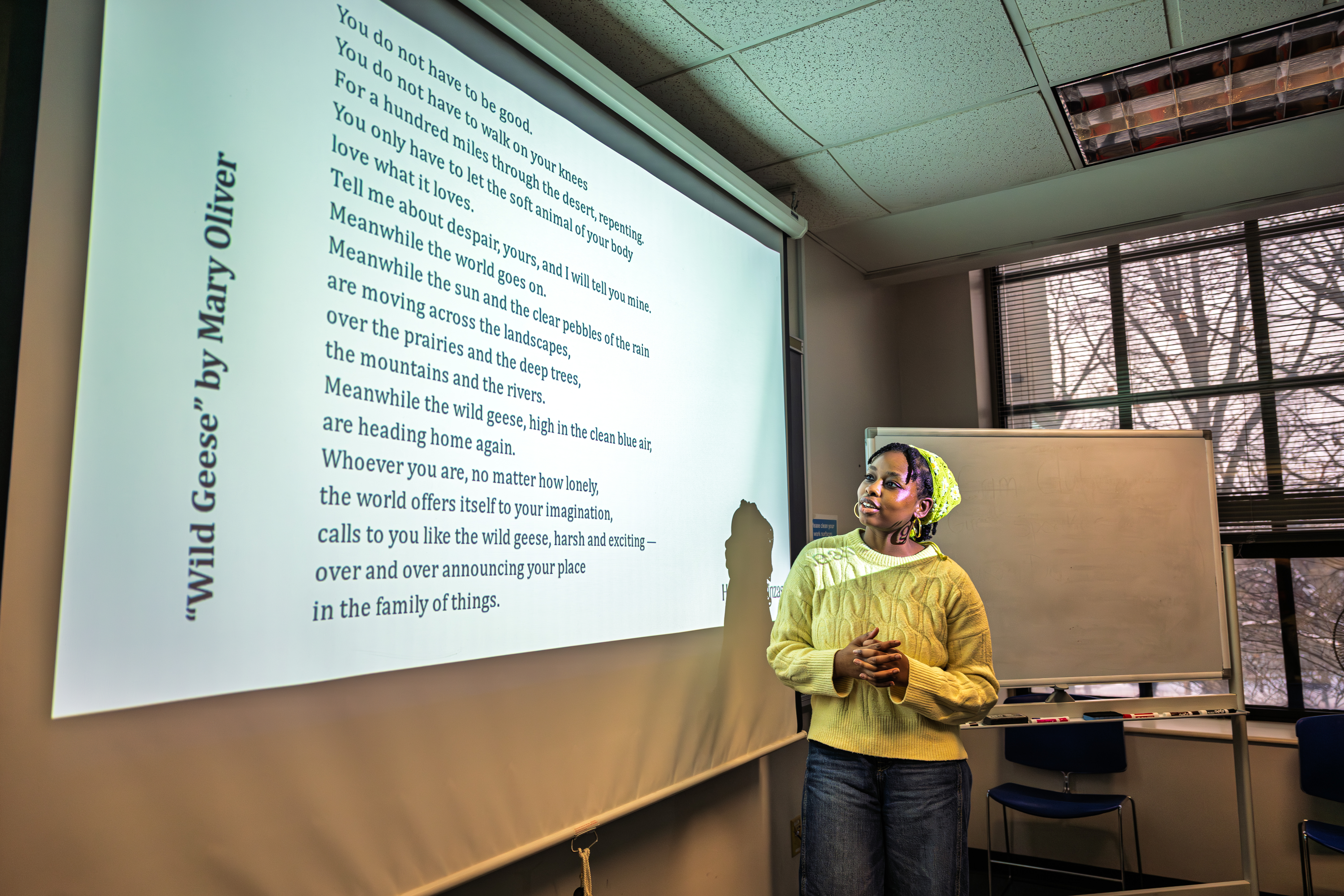
For the Healing Stanzas project, the research team designed a rigorous study involving approximately 500 first-year experience students—243 in the treatment group and 240 in the control group. The intervention was simple but powerful: students were introduced to Mary Oliver's poem "Wild Geese," encouraged to discuss it, and then invited to write their own stanzas. Those student-created stanzas were immediately projected anonymously for the class to see and later published on the Wick Poetry Center's Healing Stanzas webpage.
As the poem unfolds, students begin to recognize themselves in its lines about belonging, self-compassion, and finding one's place "in the family of things."
"I like this line—'you do not have to walk on your knees,'" one student reflects. "It's just like a very comforting reminder that whatever you've got going on, it's okay."
Another student connects the poem to self-compassion: "Rather than just beating yourself up, being more kind to yourself. We as humans, when we make a mistake, we try to go the extra mile to fix it. We're hard on ourselves. You don't have to."

Measuring What Matters
Using validated mood measurement tools—including innovative emoji-based scales that allowed students to slide indicators showing their emotional state—researchers measured students' moods before and immediately after the poetry intervention.
The results were statistically significant: engaging with poetry and writing expressively had an immediate positive effect on students' moods.
"We can say that there is a direct impact on mood states immediately after these students engage with poetry and wrote poetry," Stacey said. "To be able to say that there's a bump in mood is helpful when universities have to decide with limited resources what they're going to invest in."
More Than an Intervention
For Stacey, the project represents something deeper than data points. It's about recognizing students as whole people, not just receptacles for information.
"Something like a poetry intervention honors all of the things that are happening in students' lives outside of the classroom, and it encourages them to bring that to the classroom," Stacey said.
"It's an outdated model to think that students leave themselves at the door, and then they come in, and you deposit information, then they go back out." -- Clare Stacey, Ph.D.
The classroom transformations were visible. Stacey recalls a student—quiet all semester, sitting in the back wearing a baseball cap—who suddenly opened up during the poetry intervention, sharing how he felt like the geese in Oliver's poem, struggling to find belonging at college.
"All of a sudden that student has a place in that classroom to speak, because you've connected with them on a level that's not about the content directly of your class," Stacey said. "It creates belonging in the classroom when you use these creative mechanisms to reach a student."
This aligns with Stacey's broader teaching philosophy in sociology. In her classroom discussions of the Mary Oliver poem, students grapple with profound questions about self-compassion, belonging, and what it means to find your place in the world—the same sociological questions about identity, community, and social support that drive her research.

Looking Forward
While the team's application for a large federal grant wasn't funded, they're regrouping to expand the research. The pilot study proved the concept works. Now they want to test it more systematically across different environments and time periods.
The project has already influenced how some Kent State faculty approach teaching. Professors in biological sciences and physics have begun incorporating poetry into their classrooms, recognizing that emotion is central to learning.
"Emotion is how we learn. We filter everything through emotion," Stacey said. "If you cannot create a space for students to learn, you're not going to get the content across."
The Healing Stanzas Project demonstrates what's possible when universities invest in students' holistic well-being—when they recognize that academic success and mental health aren't separate concerns but deeply interconnected.