

When Forest Lawn Stormwater Park opened on the site of Boardman Ohio's Market Street Elementary School, it became something rare: a community wetland with deep roots. For the students whose parents once attended that school, the land carried memory. For Kent State University researchers, it held data. This spring, those two worlds converged.
Nearly 50 Boardman High School and Glenwood Junior High students spent a day in the field alongside Kent State scientists, collecting water samples, documenting plant life, observing aquatic organisms, and gathering environmental data at the park along Market Street — part of a new grant-funded partnership with the H2Ohio Wetland Monitoring Program, which monitors more than 40 wetlands across Ohio.
The three-day engagement was built around a simple but powerful idea: that science is not just a set of facts to be learned, but a process to be experienced.
"There are so many platforms that teach students about what wetlands are and why they're so great," said Lauren Kinsman-Costello, Ph.D., associate professor in the Department of Biological Sciences and research lead of the H2Ohio Wetland Monitoring Program. "But I'm always more interested in giving people that authentic experience — seeing what you can see that you can't see just by looking at a piece of paper."
The three days were carefully sequenced. On day one, Kent State team members led a classroom activity introducing students to water quality concepts, including a hands-on design exercise in which students built their own model wetlands. Day two brought everyone into the field at Forest Lawn, where students rotated through stations led by graduate students and research staff, each focused on a different type of data collection. On day three, students returned to the classroom to analyze the data they had gathered — combining it with historical data from Kent State's ongoing monitoring work.
"The fact that these teachers are really excited about that data analysis piece at the very end is what really makes me double down on this partnership," Kinsman-Costello said. "It really closes that loop."
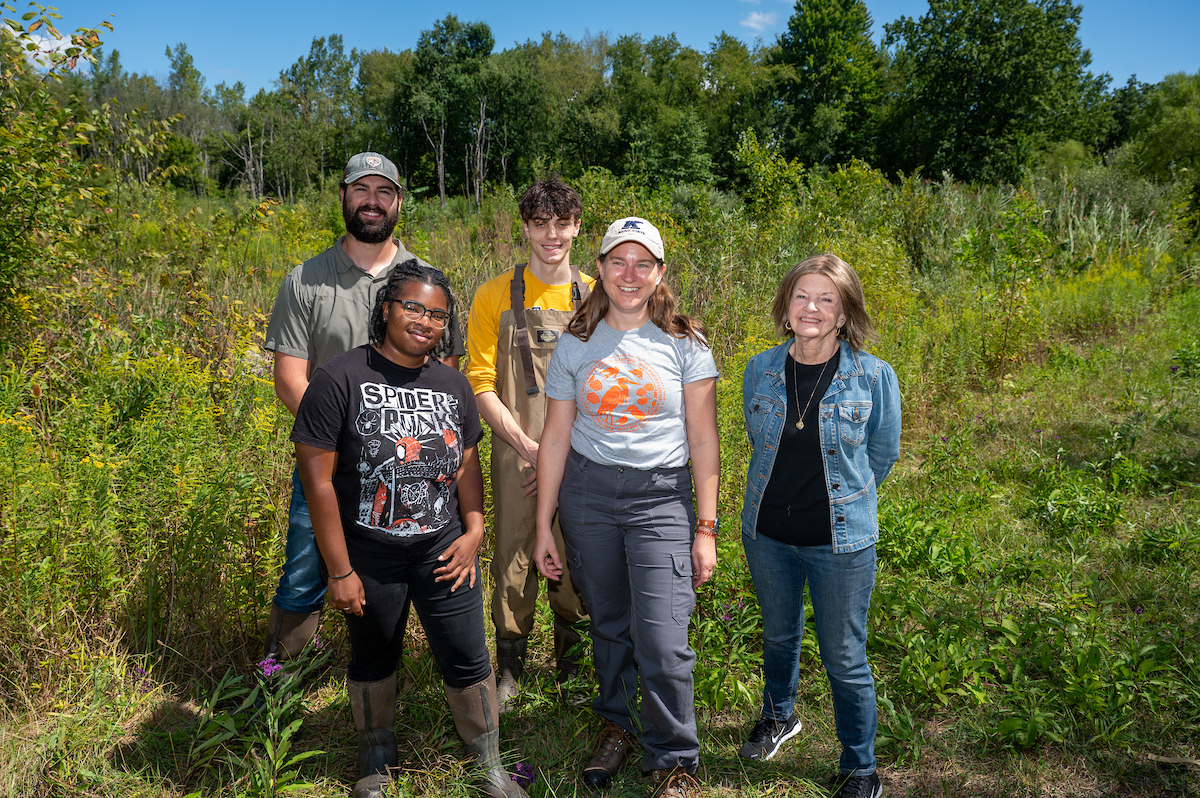
The field day was led by a team spanning both Kinsman-Costello's lab and that of Dave Costello, Ph.D., including research technicians, graduate students, postdoctoral researchers, and undergraduate volunteers. Local Youngstown television stations WFMJ and WKBN-27 both covered the event.
To see the news coverage:
WFMJ YouTube link: Students Work Alongside Kent State Researchers
WKBN-27-Boarman Students Return to Former Elementary School Site to Help Scientists
The partnership is supported by a seed grant from Kent State's Community Engaged Research Institute (CERI), awarded to Kinsman-Costello and co-investigator Patrick Bitterman, Ph.D. of the Department of Geography, with community investigator Scott Lenhart, a Boardman High School AP Computer Science teacher. The project, titled "Building Local Capacity for Water Science and Management in Northeast Ohio", pairs environmental data collection with analysis of the social and institutional networks that shape how wetlands like Forest Lawn are designed, managed, and governed.
“We are pleased to support Professor Kinsman-Costello’s work with Boardman students," Carla Goar, Ph.D., Director of the Community Engaged Research Institute at Kent State, said. "This project reflects the vital role universities play as engaged partners, deeply embedded in the regions they serve and committed to addressing pressing issues through collaboration and shared expertise."
This summer, Lenhart and two Kent State Student Undergraduate Research Experience (SURE) students will each design and carry out independent research projects centered on the wetland. During the academic year, the group will collaborate to develop inquiry-based curriculum — with a particular goal of training high schoolers to teach middle schoolers, creating a cascading, peer-to-peer learning model that the school district hopes to sustain for years.
The CERI grant is designed as pilot funding toward a competitive proposal to the National Science Foundation's Science of Science program, which will ask a broader question: when communities are engaged in monitoring the environments around them, does it lead to science that supports their own environmental goals?
"We've been looking for opportunities to develop community-engaged sampling for two reasons," Kinsman-Costello said. "We need the data — people who live right next to a wetland can get there during a storm much faster than we can. And it gives us so much contextual information about the wetland that we couldn't get any other way."
Read more about how Ohio’s restored wetlands are filtering nutrients before they reach Lake Erie.
# # #